
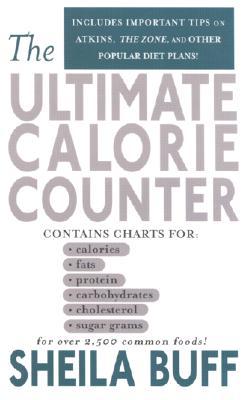
The Ultimate Calorie Counter
- Binding: Paperback
- Publisher: St Martins Pr
- Publish date: 09/01/2002
Description:
Chapter One CALORIES COUNT Are you overweight? You're not alone. Today more than half of all adult Americans weigh at least 20 percent more than their ideal weight, and nearly a quarter of them weigh far more than that. Would you like to lose weight? You're not alone there either. At any given time, about a quarter of all adult Americans are on a diet. Americans spend $33 billion annually on weight-loss products and services, but despite all that money, the number of overweight people continues to rise. In today's world of fast-food restaurants, convenience foods, and busy schedules that leave little time for exercise, it's all too easy to become overweight by taking in too many calories and using too few. Reversing the process isn't quite as easy, but it's nowhere near as hard as you might think. In fact, you don't even have to go on a diet to do it. All you have to do is reduce your daily calorie intake by a small amount and increase your daily activity, also by just a small amount each day. When you take in fewer calories than you use-even by a small amount-you lose weight, steadily, safely, and for good. What you're doing is counting calories, a weight-loss approach that is the simplest and probably most successful method of all. Teaching you how to track your daily calories and cut back on them easily is what this book is all about. WHAT'S A CALORIE? If you're going to lose weight the calorie-counting way, a good place to start is by understanding exactly what a calorie is. A calorie is a unit of energy. To be precise, 1 calorie is the amount of heat (another way of saying energy) it takes to raise the temperature of 1 gram of water by 1 degree Celsius. So, if you burned a chocolate chip cookie completely and measured the amount of heat it gave off, you could then figure out how many calories the cookie contained. As it turns out, the cookie will give off about 50,000 calories. When dealing with the calories in foods, though, nutritionists make the numbers easier to deal with by giving them in kilocalories. There are 1,000 calories in 1 kilocalorie, so our chocolate chip cookie contains 50 kilocalories (abbreviated Kcal). The kilo part of kilocalories gets dropped when it comes to food labels and the like, so for all practical purposes our chocolate chip cookie is said to contain 50 calories. By measuring the number of calories in a food, we're actually measuring how much energy that food contains. The foods we eat are made up of three basic components: carbohydrates (starches and sugars), protein, and fat. There are 4 calories in every gram of carbohydrate and protein, and there are 9 calories in every gram of fat. So, the 50 calories in that chocolate chip cookie come from the sugar and flour (carbohydrates), the eggs and milk (protein), and the vegetable oil (fat) that are in it. Your body converts the food you eat into energy to keep you alive and moving. More calories mean more energy-but only up to a point. Take in as many calories as you expend, and your body weight will stay the same. Take in more calories than you expend, however, and you will gain weight as your body stores the extra energy as fat. But if you take in fewer calories than you expend, you will lose weight as your body burns fat to make up for the missing energy. To gain 1 extra pound of weight, you have to take in approximately 3,500 more calories than you expend. And to lose 1 pound of weight, you have to expend approximately 3,500 more calories than you take in. Don't panic-3,500 calories may sound like an impossibly big number, but it really isn't. To lose a pound in a week, you'll need to expend 500 more calories every day than you take in. That actually gives you a lot of flexibility. You could cut 500 calories from your daily diet, but that probably would mean feeling hungry all week. It's much simpler to cut just 250 calories from your daily intake and increase your activity level by another 250 calories. As you'll discover from the calorie counter in Chapter 6, it's easy to cut 250 calories from your diet. There are about 250 calories in just two ounces of potato chips, in just one candy bar, or in just three Oreos. As you'll learn in Chapter 3, there are plenty of delicious, low-calorie substitutes for junk-food snacks. And by replacing empty calories in your diet with high-quality ones, you'll be getting better overall nutrition while you lose weight. It's also easy to increase your activity level by 250 calories. As you'll learn in Chapter 4 on exercise, a 30-minute walk not only burns off about 130 calories, it gives you a lot of other health benefits as well. Sneak in some additional exercise besides your walk-take the stairs instead of the elevator, for example-and you're well on your way to using more calories than you take in. The result is weight loss. It's that simple. HOW MANY CALORIES DO YOU NEED? Before you decide how many daily calories you should eliminate from your diet, figure out how many you need to take in. About 66 percent of the calories you eat each day go to keep your body functioning normally. These are the calories that you use to keep your heart beating, your lungs breathing, your digestive system working, and so on. You burn them even when you're sleeping. About 10 percent of the calories you take in go for digesting and metabolizing your food. The rest go toward physical activity-all the moving around you do as a normal part of your daily activities. Most of your leftover calories are stored in your body as fat. How many calories do you need each day to maintain your current weight? That depends a lot on who you are and how active you are, but you can use a simple formula to get a pretty good idea. Let's start with what nutritionists call your basal metabolism rate (BMR). That's the number of calories you need just to maintain your basic body functions and stay alive. To find your BMR if you're a woman, take your current weight in pounds and multiply it by 10. If you're a man, multiply your current weight by 11. The result is your basal metabolism rate. So, a woman who weighs 145 pounds has a BMR of 1,450 calories a day (145 10 = 1,450). A man who weighs 180 pounds has a BMR of 1,980 calories a day (180 11 = 1,980). To figure out how many calories you need each day beyond your BMR, you'll need to estimate how active you are, using a measure called the lifestyle. percentage (L%). This number is found by estimating how active you are as a percentage of your basal metabolism rate. It's less complicated than it sounds. Start by finding the lifestyle percentage that best fits your activity level: Sedentary (lifestyle with little physical activity): Your L% is 20 percent of your BMR. Somewhat active: Your L% is 30 percent of your BMR . Moderately active: Your L% is 40 percent of your BMR . Very active: Your L% is 50 percent of your BMR . To determine your daily calorie needs, add your BMR and your lifestyle percentage together. So, going back to our example, let's assume you're a somewhat active 145-pound woman. Your BMR is 1,450 calories a day, and your lifestyle percentage is 30 percent of that, or an additional 435 calories (1,450 .30 = 435). Add your BMR and your lifestyle percentage together, and you come up with a daily calorie total of 1,885 (1,450 + 435 = 1,885). That's the number of calories you need each day to maintain yourself at your current level of weight and activity. As a rough rule of thumb, you can estimate that a moderately active woman needs about 2,000 calories a day and a moderately active man needs about 2,500 calories a day. Eat more calories than that or become less active, and you'll gain weight. Eat more and become less active, and you'll gain weight faster. The opposite is also true. Eat fewer calories or become more active, and you'll lose weight. Eat less and become more active, and you'll lose weight faster. The combination of reduced calorie intake and increased activity is the true secret of painless, permanent weight loss. When you learn how to count your daily calories and keep them to the right number for you, you'll be able to balance your energy equation and control your weight. ARE YOU OVERWEIGHT? Before you start counting calories to lose weight, it's important to have an accurate idea of exactly how overweight you are. That will help you set a realistic goal for weight loss and help you maintain your new weight. Traditionally, the ideal weight for your height was determined by a table originally compiled by the Metropolitan Life Insurance Company. The table gave weights depending on your frame-light, medium, or heavy. That's a pretty subjective measurement, however, because you can't Table 1.1 Weight-for-Height Chart Height Weight in Pounds 19 to 34 years Over 35 yeas 5 ft 0 in971281081385 ft 1 in1011321111435 ft 2 in1041371151485 ft 3 in1071411191525 ft 4 in1111461221575 ft 5 in114-1501261625 ft 6 in118-15513016
Expand description
Product notice
Returnable at the third party seller's discretion and may come without consumable supplements like access codes, CD's, or workbooks.
| Seller | Condition | Comments | Price |
|
HPB-Diamond
|
Very Good

|
$5.83
|
|
Half Price Books Inc
|
Very Good
|
$5.83
|
|
BooksRun
|
Good
|
$6.23
|
|
Wonder Book - Member ABAA/ILAB
|
Very Good |
$7.66
|
|
Cheryls-Books
|
Good |
$11.66
|

Please Wait